Fish Amok
55 min · 4 people · Asian Dishes · Cambodia
Published on 4 November 2026
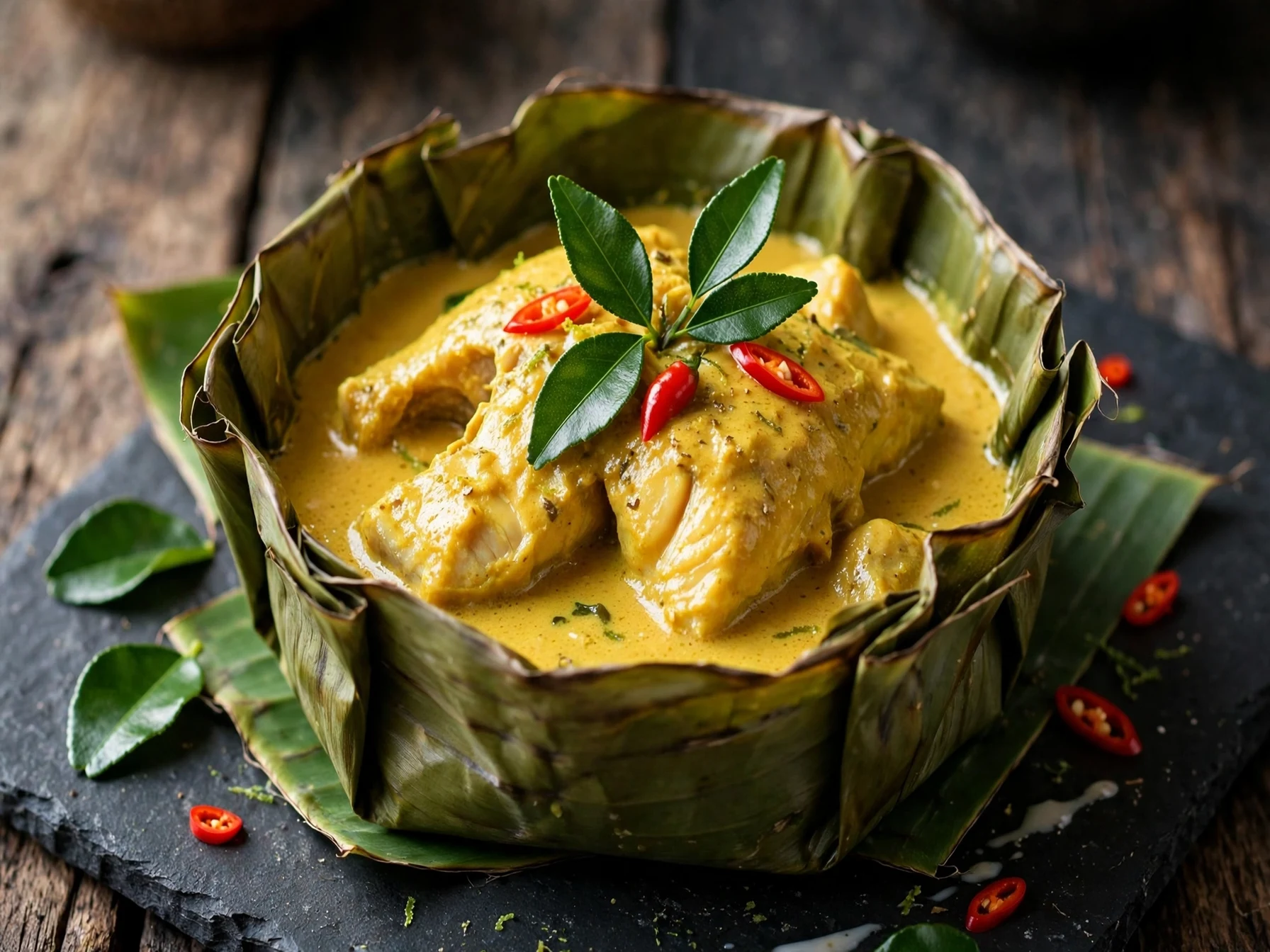
Fish Amok, or Amok Trey, is Cambodia's national dish — white fish gently steamed in banana leaf cups in a fragrant coconut curry built on kroeung, the Khmer spice paste of lemongrass, galangal, turmeric, garlic, shallots and kaffir lime leaves. Eggs give the curry a soft, custard-like set, and the banana leaf adds a subtle earthy aroma that no ramekin can match. It looks impressive on the table, yet the work is mostly in the paste and the steaming — once the cups are filled, the steamer does the rest, and the amok is served hot with steamed rice, garnished with kaffir lime leaves and red chilli.
Open the interactive recipe — switch language, watch the video, save itVideo coming soon, this recipe is being filmed, so check back soon to watch every step.
Ingredients
- White fish fillet 500 g (catfish, tilapia or snapper)
- cut into bite-sized pieces
- Coconut milk 1 cup
- Coconut cream 1/2 cup
- Eggs 2 (beaten)
- Kroeung paste 3 tbsp (2 stalks lemongrass, 2 shallots, 2 garlic cloves, 1 small piece galangal, 1 tsp fresh turmeric, 2 kaffir lime leaves, 1 tsp shrimp paste)
- Fish sauce 1 1/2 tbsp
- Palm sugar 1 tsp
- Banana leaves 2-3
- cut into squares (or small ramekins)
- Red chilli 1 (thinly sliced)
- and kaffir lime leaves
- finely sliced
- to garnish
Nutrition (approx. per serving)
409 calories · Protein 29.1 g · Fat 29.8 g · Saturated fat 23.7 g · Carbs 9.5 g · Sugar 4.7 g · Fiber 2.5 g · Sodium 592 mg
Method
- Pound the lemongrass, shallots, garlic, galangal, turmeric, kaffir lime leaves and shrimp paste into a smooth kroeung paste, using a pestle and mortar or a small blender with a splash of water.
- Whisk the coconut milk, coconut cream, 3 tbsp kroeung paste, fish sauce, palm sugar and beaten eggs in a large bowl until completely smooth.
- Cut 500 g white fish into bite-sized pieces, fold them into the coconut mixture and leave to marinate for 15 minutes.
- Soften the banana leaves by passing them briefly over a flame or dipping them in hot water, then fold them into cups and secure with a cocktail stick if needed (or use small ramekins).
- Spoon the fish mixture into the cups, filling them about three-quarters full so the custard has room to set.
- Place the cups in a steamer over boiling water, cover and steam for 20-25 minutes, until the curry is set and custard-like.
- Spoon a little coconut cream over the top of each cup and steam for 2-3 minutes more.
- Garnish with finely sliced kaffir lime leaves and red chilli, and serve hot with steamed rice.
Chef's tip
Do not overfill the banana leaf cups — three-quarters full leaves room for the mixture to set without spilling. The amok is done when it is firm to the touch but still moist, like a soft custard, never dry.
Serving
Serve the amok hot in its banana leaf cup, opened at the table, with a bowl of steamed jasmine rice. Spoon a little coconut cream over the top and scatter sliced kaffir lime leaves and red chilli. One cup per person is a generous main course; in Cambodia it is often part of a shared meal with a soup and a salad.
Storage and reheating
Refrigerate leftover amok in a closed container and eat within 1 to 2 days. Reheat gently by steaming for 8-10 minutes until hot through — microwaving works but can dry the edges. Do not freeze amok; the egg custard turns rubbery and weeps when thawed.
Ingredient notes
- Use a firm white fish that holds its shape when steamed — catfish, tilapia or snapper are the classic choices. Soft, flaky fish breaks apart and the amok turns mushy instead of setting into slices.
- Make the kroeung fresh if you can. A pounded paste of lemongrass, galangal, turmeric, garlic, shallots and kaffir lime leaves gives a far brighter flavour than a jarred curry paste, and it is what makes amok taste Khmer rather than Thai.
- Do not skip the eggs — they are what set the curry into a soft custard. Without them the mixture stays a thin sauce and will not hold its shape when the cup is opened.
- Noni leaves are the traditional lining for the banana leaf cups and add a slightly bitter, herbal note; if you cannot find them, the banana leaf alone is fine and is how most home cooks make it.
Variations
- Amok with chicken or prawns: replace the fish with the same weight of diced chicken thigh or peeled prawns and steam for the same time; prawns need only 15-18 minutes.
- Vegetarian amok: replace the fish with 500 g mixed mushrooms and tofu, use soy sauce instead of fish sauce and leave out the shrimp paste.
- Spicier amok: add 1 tsp chilli paste to the kroeung, or stir a sliced bird's eye chilli into the mixture before steaming.
Common mistakes
- Overfilling the banana leaf cups. More than three-quarters full and the mixture spills over as it sets, or the cup splits under the weight.
- Steaming on too high a heat or for too long. The custard turns rubbery and dry instead of soft and moist — keep the water at a steady simmer and check at 20 minutes.
- Using a jarred curry paste instead of kroeung. Thai curry pastes are much hotter and lack the galangal and kaffir lime balance that makes amok taste Cambodian.
- Skipping the marinating step. Folding the fish straight into the cups without 15 minutes in the coconut mixture leaves the fish bland in the middle.
Frequently asked questions
What is Fish Amok?
Fish Amok, or Amok Trey, is Cambodia's national dish: white fish steamed in banana leaf cups in a coconut curry made with kroeung, the Khmer spice paste of lemongrass, galangal, turmeric, garlic, shallots and kaffir lime leaves. Beaten eggs set the curry into a soft, custard-like texture.
Can I make Fish Amok without banana leaves?
Yes. Small ramekins, heatproof bowls or foil cups work just as well — fold the mixture in, cover loosely with foil and steam the same way. You lose the subtle earthy aroma of the leaf, but the flavour and texture are the same.
What fish is best for Fish Amok?
A firm white fish such as catfish, tilapia or snapper, cut into bite-sized pieces. Catfish is the traditional choice in Cambodia. Avoid very soft or oily fish, which fall apart during steaming.
What is kroeung, and can I buy it ready-made?
Kroeung is the Khmer aromatic paste at the heart of Cambodian cooking, pounded from lemongrass, galangal, turmeric, garlic, shallots and kaffir lime leaves, often with shrimp paste. Freshly pounded kroeung tastes far brighter; if you cannot make it, a yellow curry paste is the closest substitute, but the flavour will be hotter and less fragrant.
More
More Asian Dishes recipes · More Cambodia recipes · All recipes · Cooking FAQs · Trending Recipes
Share this recipe: ·