Ema Datshi
25 min · 2 people · Asian Dishes · Bhutan
Published on 4 November 2026
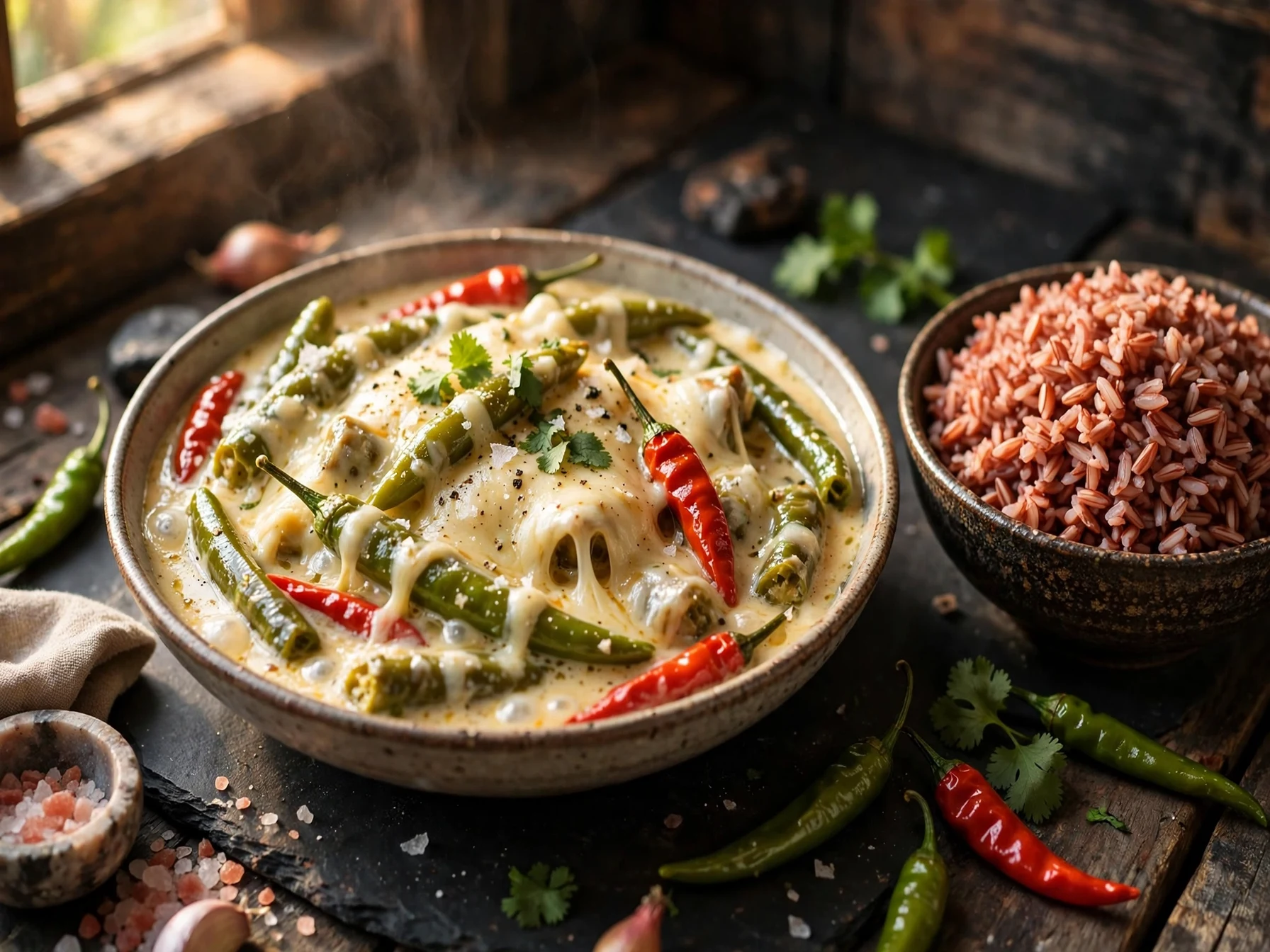
Ema Datshi is Bhutan's national dish — 'ema' means chilli and 'datshi' means cheese in Dzongkha. In Bhutan chillies are treated as a vegetable, not a seasoning: 220 g of chillies are simmered with onion, tomato and garlic until soft, then the heat is switched off and grated cheese is stirred in until it melts into a creamy sauce that coats every chilli. It is fiery, rich and deeply comforting, and it is eaten in Bhutanese homes almost every day, served hot over a bed of boiled red rice. The recipe needs only a handful of ingredients and one pan, but it rewards care: the chillies must soften without turning to mush, and the cheese must melt off the heat, or the sauce turns grainy.
Open the interactive recipe — switch language, watch the video, save itRecipe Video
Ingredients
- Jalapeno chillies 220 g
- quartered lengthwise
- Green chillies 6 g
- slit (2 small green chillies)
- Onion 70 g (sliced)
- Garlic 15 g
- roughly chopped (about 3 cloves)
- Tomato 50 g (diced)
- Cheese 75 g
- grated (datshi, or feta, mozzarella or farmers cheese)
- Butter 15 g
- Vegetable oil 7 g
- Salt 5 g
- Water 250 g (about 1 cup)
Nutrition (approx. per serving)
246 calories · Protein 7.5 g · Fat 18.1 g · Saturated fat 10 g · Carbs 15.6 g · Sugar 8.3 g · Fiber 4.2 g · Sodium 1448 mg
Method
- Remove the stalks from the chillies and cut them in quarters lengthwise. Slit the 2 small green chillies, slice the onion, roughly chop the garlic, and dice the tomato.
- Add all of these to a pan along with the salt, the vegetable oil and 250 g of water.
- Cover the pan with a lid and boil on medium heat for 15 minutes, until the chillies have softened.
- Turn off the heat and add the butter and the grated cheese. Turning the heat off before adding the cheese stops it from curdling.
- Stir gently until the cheese has melted into a creamy sauce that coats the chillies.
- Taste and check the salt, and adjust it — how much you need depends on how salty your cheese is.
- Cook red rice separately while the stew simmers, and keep it hot.
- Serve the Ema Datshi hot over a bed of boiled red rice.
Chef's tip
Turn the heat OFF before adding the cheese. Cheese added over direct heat curdles and goes grainy; stirred into the hot stew off the heat, it melts into a smooth, creamy sauce.
Serving
Serve hot over boiled red rice, so the sauce soaks into the rice. In Bhutan it is eaten almost every day, often with boiled rice and another vegetable or lentil dish alongside. One bowl is enough — it is fiery and rich.
Storage and reheating
Refrigerate leftover Ema Datshi in a closed container and eat within 1 to 2 days. Reheat gently on low heat, adding a little water or milk if the sauce has thickened. Do not freeze it — the cheese sauce splits and the texture turns grainy.
Ingredient notes
- Use fresh, firm chillies. Jalapenos are a mild stand-in; traditional Bhutanese chillies are much hotter, so add more green chillies if you want the authentic heat.
- Always turn off the heat before adding the cheese. Cheese added to a boiling stew curdles and goes grainy, which ruins the sauce.
- Use a cheese that melts well — datshi, feta or mozzarella. A hard, aged cheese does not melt properly and the sauce never turns smooth.
- Taste the cheese before adding more salt. Cheeses like feta are already salty, so it is easy to over-salt the stew.
Variations
- Kewa Datshi: add potatoes to the stew — cook chopped potatoes with the chillies until tender.
- Shamu Datshi: add sliced mushrooms with the chillies; they give the cheese sauce an earthy flavour.
- Mild version: remove the seeds and membranes from the chillies and use fewer green chillies, or replace half of them with bell pepper.
Common mistakes
- Adding the cheese over direct heat. The cheese curdles and goes grainy, and the sauce never turns smooth.
- Overcooking the chillies. Boiling them too long leaves the chillies soft and shapeless.
- Adding all the salt without tasting the cheese. With a salty cheese, the stew is easily over-salted.
- Using too little cheese or too much water. The sauce stays thin and watery instead of creamy.
Frequently asked questions
Is Ema Datshi very spicy?
Yes — chilli is the main ingredient of the dish, not a seasoning. To lower the heat, remove the seeds from the chillies, use jalapenos, or increase the amount of cheese.
What cheese can I use if I cannot find datshi?
Feta, mozzarella or farmers cheese work well. Choose a cheese that melts easily; a hard, aged cheese will not make a smooth sauce.
What is Ema Datshi served with?
Traditionally with boiled red rice, the staple grain of Bhutan. White rice or tingmo (steamed bread) also work.
Can I make it ahead of time?
It tastes best fresh. Keep leftovers in the fridge and reheat gently on low heat within 1 to 2 days; the sauce may thicken, so add a little water.
More
More Asian Dishes recipes · More Bhutan recipes · All recipes · Cooking FAQs · Trending Recipes
Share this recipe: ·