Ambuyat
25 min · 4 people · Asian Dishes · Brunei Darussalam
Published on 4 November 2026
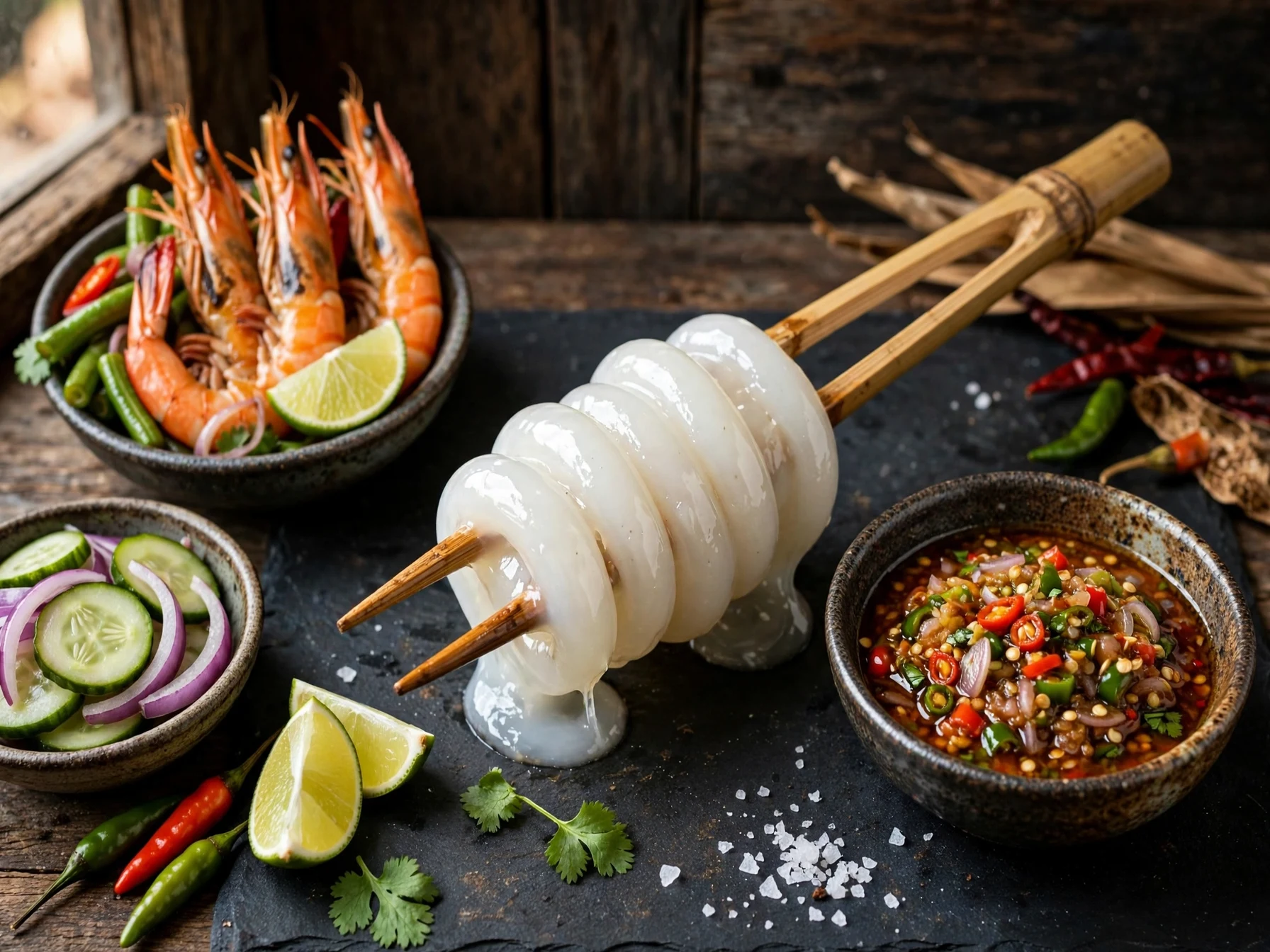
Ambuyat is the national dish of Brunei Darussalam — sago palm starch mixed with water and stirred with boiling water until it turns into a glossy, translucent, glue-like mass. It is almost tasteless on its own, so it is wound onto bamboo sticks called candas and dipped into a fiery cacah sauce of chilies, shrimp paste and lime, and eaten with grilled prawns, fish and vegetables. It is swallowed without chewing, traditionally, and it is incomplete without at least three side dishes and dips to go with it.
Open the interactive recipe — switch language, watch the video, save itRecipe Video
Ingredients
- Sago starch 1 cup (or tapioca starch as a substitute)
- Cold water 1/2 cup
- Boiling water 3 cups
- Fresh red chilies 5-7 (for the cacah)
- Bird's eye chilies 2-3 (optional, for extra heat)
- Belacan (shrimp paste) 1 tbsp (toasted)
- Lime juice 2 tbsp (from 1-2 limes)
- Shallot 1 small
- Sugar 1/2 tsp
- Salt 1/4 tsp
Nutrition (approx. per serving)
138 calories · Protein 1.3 g · Fat 0.2 g · Saturated fat 0 g · Carbs 33.1 g · Sugar 2.9 g · Fiber 1 g · Sodium 220 mg
Method
- Put 1 cup sago starch in a heatproof bowl, add 1/2 cup cold water and stir well with a spoon or spatula until you have a smooth, lump-free paste. This step is crucial for preventing lumps later.
- Bring 3 cups water to a rolling boil in a kettle or pot.
- Slowly pour the boiling water into the sago paste in a thin stream while continuously stirring vigorously. The mixture will immediately begin to thicken and turn translucent.
- Keep stirring until the entire mixture transforms into a thick, sticky, gelatinous mass. It should be mostly clear with a slight opalescent sheen.
- Once fully transformed, let the ambuyat sit for 1-2 minutes. It will become even firmer. Transfer to a communal serving bowl and serve immediately while warm.
- If your belacan is not already toasted, gently toast 1 tbsp in a dry pan over low heat for 1-2 minutes until fragrant. Be careful not to burn it.
- Roughly chop the chilies and the shallot. In a mortar and pestle, or a small food processor, pound the toasted belacan, chilies, shallot, 1/2 tsp sugar and 1/4 tsp salt until you get a coarse paste.
- Stir in 2 tbsp lime juice, taste and adjust the seasoning, and transfer the cacah to a small serving bowl. Wind a little ambuyat onto bamboo candas, dip it into the cacah, and eat it with grilled prawns, fish and vegetables.
Chef's tip
Mix the starch into a smooth paste with cold water first — this is the step that prevents lumps. Pour the boiling water in a thin stream and never stop stirring, or the starch sets in lumps instead of turning glossy and smooth.
Serving
Serve warm in a communal bowl, with the cacah in a small bowl and grilled prawns, fried fish, steamed vegetables and cucumber and carrot slices around it. Wind a small ball onto the candas, dip it, and swallow without chewing — that is the traditional way.
Storage and reheating
Ambuyat is best eaten fresh and warm. It firms and dries as it cools and does not reheat well; make only as much as you will eat at once. The cacah sauce keeps refrigerated for a day.
Ingredient notes
- Ambuyat itself is almost tasteless — it is a neutral starch base, like rice or noodles, and the cacah sauce and side dishes carry all the flavour.
- Dip the candas in a little starch water before winding, so the ambuyat grips the sticks instead of sliding off.
- Serve immediately while warm. As it cools the ambuyat firms up and loses its glossy, stretchy texture.
- Tapioca or potato starch can replace sago starch, but the texture is slightly less elastic than true sago.
Variations
- Tempoyak cacah: pound 2 tbsp fermented durian (tempoyak) with 1 chili, 1 tsp shrimp paste and 1 tbsp dried shrimps, then loosen with a little hot water.
- Tamarind cacah: simmer 1 cup tamarind juice with 2-3 minced garlic cloves, 1-2 chopped chilies and a pinch of salt until slightly thickened.
- Binjai cacah: pound lime, onion, garlic and binjai fruit into a sour, spicy dip — the classic sour cacah of Brunei.
Common mistakes
- Skipping the cold-water paste. Adding boiling water straight to dry starch makes lumps that never smooth out.
- Pouring the boiling water too fast or stopping the stirring. The starch sets in patches and the ambuyat turns lumpy instead of glossy.
- Serving it cold. Cold ambuyat is stiff and dull; it must be served warm, straight after it turns translucent.
- Eating it plain. Ambuyat without cacah and side dishes is almost flavourless — the dips are the dish.
Frequently asked questions
What is Ambuyat made of?
Ambuyat is made from sago starch, the white starch extracted from the trunk of the sago palm. The starch is mixed with cold water into a paste, then boiling water is stirred in until it turns into a glossy, translucent, glue-like mass.
What is cacah sauce?
Cacah is the dipping sauce served with ambuyat. The classic version is sambal belacan — red chilies, bird's eye chilies, toasted shrimp paste, shallot, sugar, salt and lime juice pounded into a coarse, fiery paste. Other cacahs use tamarind, tempoyak (fermented durian) or binjai fruit.
How do you eat Ambuyat?
With bamboo sticks called candas: twirl a small amount of ambuyat around the sticks, dip it into the cacah sauce, and swallow it without chewing. It is eaten with grilled prawns, fish, vegetables and other side dishes.
Can I use tapioca starch instead of sago starch?
Yes. Tapioca or potato starch is a common substitute and works the same way, though the texture is slightly less elastic than true sago starch.
More
More Asian Dishes recipes · More Brunei Darussalam recipes · All recipes · Cooking FAQs · Trending Recipes
Share this recipe: ·