Ilish Bhapa
40 min · 4 people · Fish Dishes · Bangladesh
Published on 4 November 2026
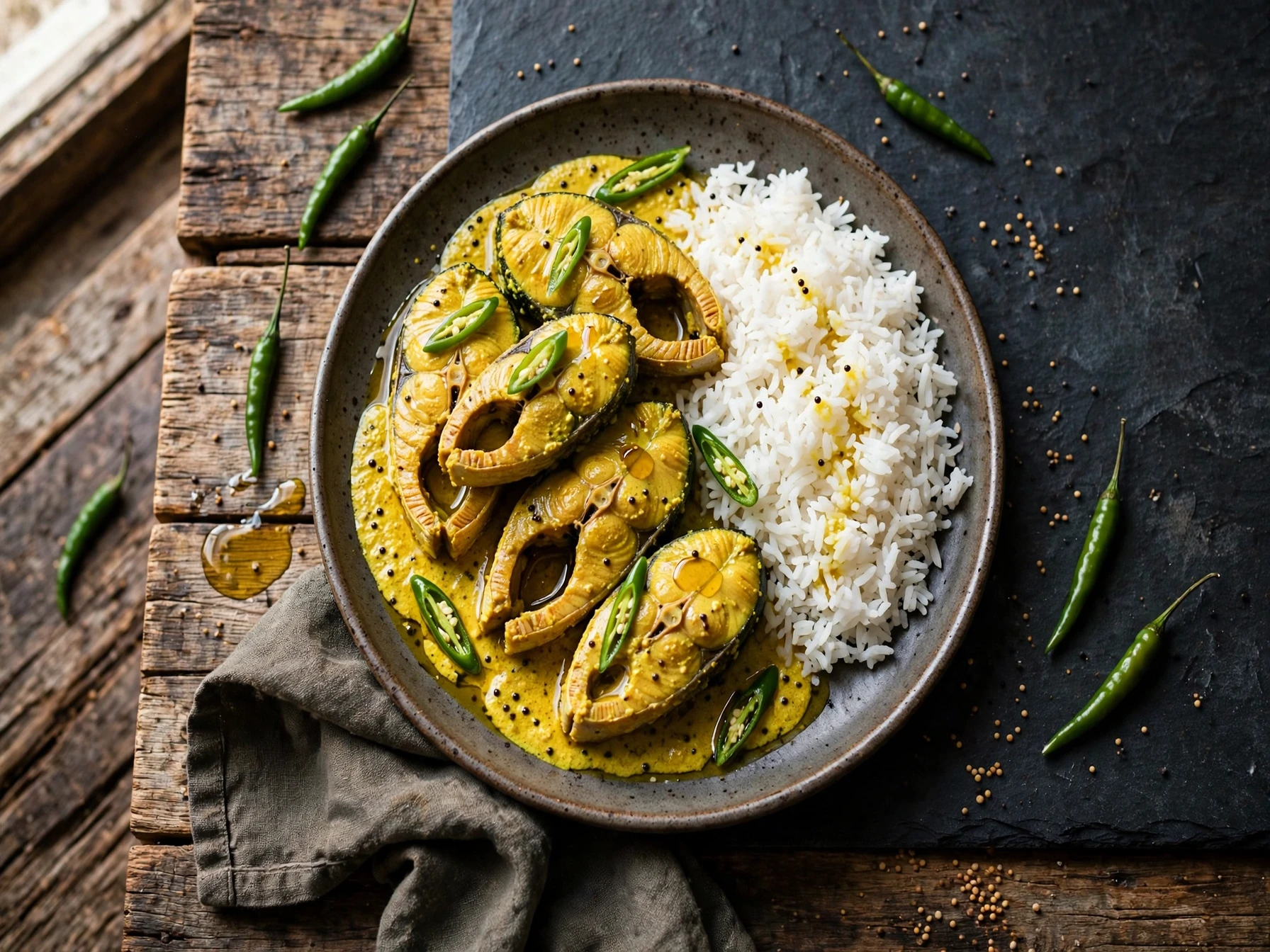
Ilish Bhapa is Bangladesh's beloved steamed hilsa — hilsa, the national fish of Bangladesh, steamed in a potent mustard, yoghurt and coconut paste with green chillies and mustard oil. The raw fish is never fried; it cooks gently in its own steam inside a sealed tiffin box, staying tender, juicy and soft, while the mustard paste turns golden and fragrant. It is the dish Bengalis serve to honoured guests, the box opened at the table to reveal the steaming fish, and it is always eaten hot with plain steamed rice. The mustard seeds need two hours of soaking before you start, so plan ahead — the active cooking takes only about 40 minutes.
Open the interactive recipe — switch language, watch the video, save itRecipe Video
Ingredients
- Hilsa fish (ilish machh) 250 g
- 4 pieces cut 3 cm thick
- Mustard seeds 40 g (brown)
- yellow mixed
- soaked for 2 hours
- Green chillies 8 pcs
- Coconut 40 g (peeled, grated)
- Yoghurt 25 g (beaten)
- Salt 22 g (Bong Eats; cross-check recipes use about 1 tsp)
- Sugar 1/4 tsp
- Turmeric powder 1/2 tsp
- Mustard oil 20 g
Nutrition (approx. per serving)
266 calories · Protein 15 g · Fat 20.4 g · Saturated fat 5.8 g · Carbs 7.7 g · Sugar 3.4 g · Fiber 2.6 g · Sodium 2178 mg
Method
- Clean the hilsa and cut it into 3-cm-thick slices, about 4 pieces from 250 g of fish.
- Soak 40 g mustard seeds in water for 2 hours. Strain, then grind with the salt and 4 green chillies to a smooth paste, pulsing briefly so the mustard does not turn bitter.
- Mix in the grated coconut, beaten yoghurt, 1/4 tsp sugar, 1/2 tsp turmeric and 20 g mustard oil until you have a thick golden paste.
- Coat the fish pieces well with the paste on all sides.
- Arrange the coated fish in a tiffin box, with the remaining 4 green chillies halved and placed over the top.
- Fasten the lid and set the fish aside to marinate for at least 15 minutes.
- Place a stand in a pan, pour in hot water up to half the height of the tiffin box, and once the water boils set the tiffin on the stand. Cover the pan and steam on medium heat for 15 minutes.
- Remove the tiffin from the pan and allow it to rest for another 5 minutes before opening and serving hot with steamed rice.
Chef's tip
Grind the mustard seeds only briefly — over-grinding makes mustard bitter. Pulse two or three times, scraping down the sides, until just smooth. And never fry the fish for this dish: raw hilsa steamed in the paste turns out tender, juicy and soft.
Serving
Serve hot straight from the tiffin box, opening the lid at the table so the fragrant steam escapes in front of everyone. Give each person one piece of fish with plenty of the golden mustard paste spooned over it, and always with plain steamed rice — the rice soaks up the pungent, oily paste and balances its heat. A wedge of lime on the side is optional, but nothing else is needed.
Storage and reheating
Refrigerate leftovers in the sealed tiffin box and eat within 1 to 2 days. Reheat gently by steaming the closed box over boiling water for about 5 minutes until hot through; do not microwave on high or refry the fish, or it will dry out. Do not freeze Ilish Bhapa — the fish turns dry and the mustard paste loses its fresh pungency.
Ingredient notes
- Soak the mustard seeds for the full 2 hours. Soft, well-soaked seeds grind into a smooth paste; dry seeds stay gritty and the paste turns harsh.
- Use brown and yellow mustard seeds mixed, as in the Bong Eats recipe. Brown seeds give the pungent kick, yellow seeds keep it mellow — all brown mustard can turn harshly bitter.
- Grind the mustard only briefly. Pulse two or three times, scraping down the sides, until just smooth — over-grinding is the main reason a bhapa turns bitter.
- Never fry the fish for this dish. Raw hilsa steamed in the paste turns out tender, juicy and soft, while fried fish dries out and dulls the mustard flavour.
Variations
- Banana-leaf bhapa: wrap the coated fish in banana leaf parcels instead of a tiffin box and steam for 30 minutes, the traditional Oh! Calcutta way — the leaf adds a gentle aroma.
- Poppy-seed bhapa: grind 1.5 tbsp poppy seeds with the mustard for a richer, nuttier paste, as in Debjani's version.
- No-coconut bhapa: leave out the coconut and add a little more yoghurt instead, for a sharper, more purely mustard flavour.
Common mistakes
- Grinding the mustard too long. Over-ground mustard turns bitter and ruins the whole dish — pulse briefly, two or three times, until just smooth.
- Frying the fish first. Bhapa means steamed: fried hilsa dries out and the delicate, juicy texture this dish is known for is lost.
- Skipping the 2-hour soak. Unsoaked mustard seeds grind into a gritty, harsh paste instead of a smooth, golden one.
- Steaming too long or with a loose lid. More than 15 minutes on medium heat makes the hilsa fall apart, and a lid that is not fastened lets the steam — and the flavour — escape.
Frequently asked questions
The recipe lists 22 g of salt — is that a lot?
Yes, it is on the high side. Bong Eats lists 22 g, but the cross-check recipes use about 1 tsp of salt. If you are unsure, start with 1 tsp, taste the paste before coating the fish, and add more only if needed.
Why did my mustard paste turn bitter?
The mustard was ground for too long, or the seeds were not soaked long enough. Soak the seeds for the full 2 hours and pulse them briefly — two or three pulses, scraping down the sides — until just smooth.
Do I need a tiffin box to make Ilish Bhapa?
A steel tiffin box with a tight lid is the classic vessel, but any lidded steel container that seals well works. Traditionally the fish is also steamed wrapped in banana leaf, which adds a gentle aroma.
Can I make Ilish Bhapa ahead of time?
You can coat the fish and marinate it in the tiffin box a few hours ahead and keep it refrigerated, but steam it just before serving so the fish stays tender. Leftovers keep in the fridge for 1 to 2 days; reheat by steaming gently for about 5 minutes.
More
More Fish Dishes recipes · More Bangladesh recipes · All recipes · Cooking FAQs · Trending Recipes
Share this recipe: ·