Haleem
270 min · 8 people · Desi Dishes · Pakistan
Published on 31 October 2026
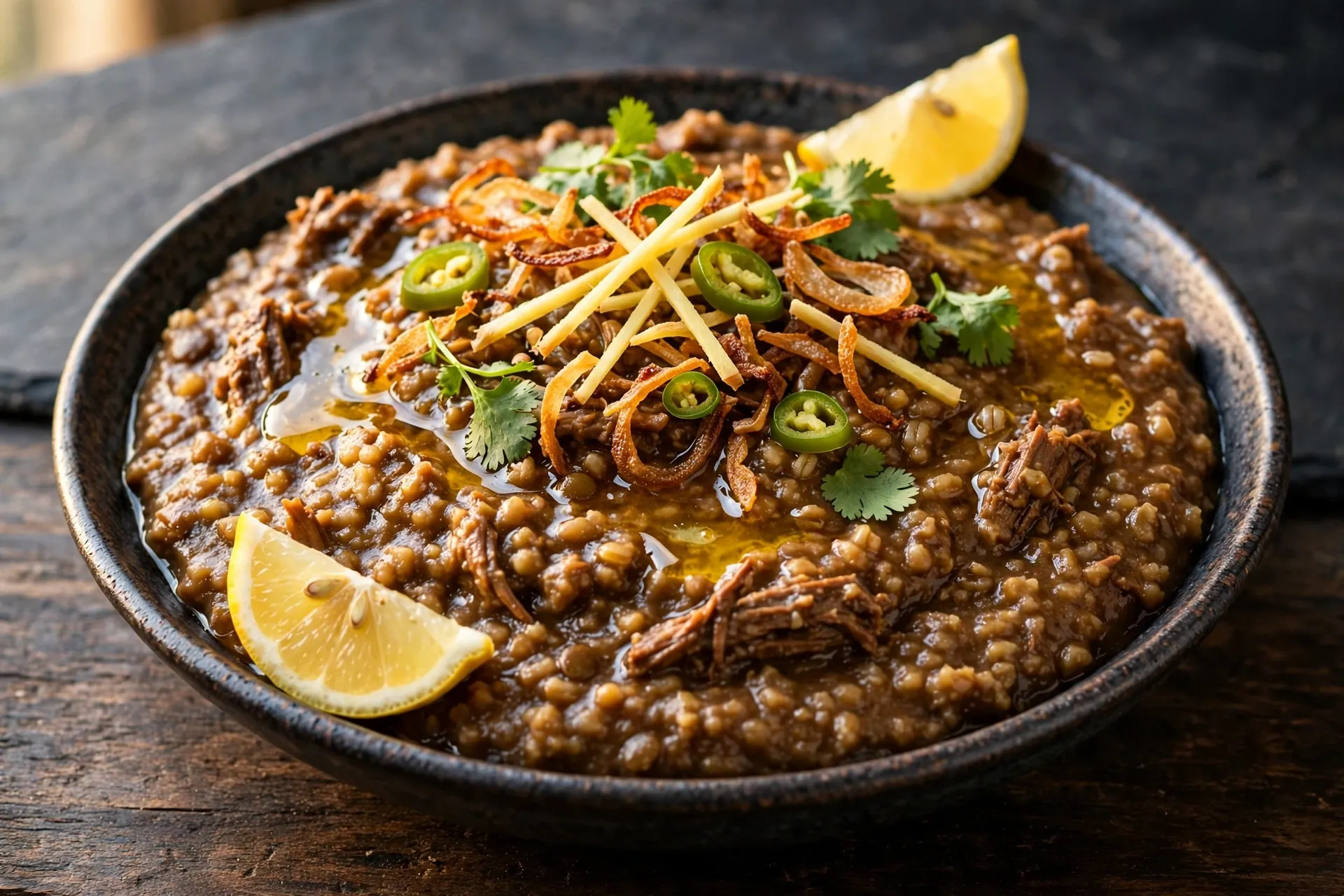
Haleem is slow food in the truest sense, a dish of patience that rewards hours of cooking with a thick, silky porridge and the famous stringy texture called resta. Wheat, barley and four lentils soak overnight, then cook until completely soft, while beef cooks separately until it shreds into fine fibres. The two are combined and mashed together in the traditional ghoota, until the grains and the meat become one. Haleem traces its roots to the Arab dish harees, brought to Hyderabad in the Mughal era and transformed over centuries into the rich dish loved across Pakistan today. It is the dish of Ramadan nights, Muharram gatherings and big family weekends, served hot with fried onions, ginger, green chillies, lemon and chaat masala.
Open the interactive recipe — switch language, watch the video, save itVideo coming soon, this recipe is being filmed, so check back soon to watch every step.
Ingredients
- Whole wheat berries (gandum) 1 cup (soaked overnight)
- Barley (jau) ½ cup (soaked overnight)
- Chana daal ½ cup
- masoor daal ¼ cup
- moong daal ¼ cup
- mash daal ¼ cup
- Beef 1 kg
- beef bones 250 g
- Ghee or oil 1 cup
- onions 2 large (thinly sliced)
- Ginger paste 2 tbsp
- garlic paste 2 tbsp
- yoghurt 1 cup (whisked)
- Red chilli powder 2 tbsp
- Kashmiri chilli powder 1 tbsp
- coriander powder 1½ tbsp
- turmeric powder 1 tsp
- Haleem masala 2 tbsp
- salt 2 tbsp
- Cumin seeds 1 tbsp
- black peppercorns 1 tsp
- cloves 6 to 8
- green cardamom 5
- black cardamom 2
- cinnamon sticks 2
- mace 2 blades
- nutmeg ¼ piece
- star anise 1
- Ghee ½ cup
- onion 1 medium (thinly sliced, for the tarka)
- Ginger 2 tbsp (julienned)
- fresh coriander ½ cup (chopped)
- fresh mint ½ cup (chopped)
- green chillies 4
- lemons 3 (for garnish)
- Chaat masala (for dusting)
Method
- Rinse the wheat, barley and all the lentils until the water runs clear, cover with plenty of fresh water and soak overnight, or for at least 8 hours. Soak the masoor, moong and mash lentils for at least 2 hours.
- Drain the soaked grains and lentils, put them in a large heavy pot with 12 cups of water, 1 tsp turmeric and 1 tsp salt, and simmer covered on low heat for 2 to 2.5 hours, until everything is completely soft and mushy.
- Roast the cumin seeds, black peppercorns, cloves, green and black cardamom, cinnamon, mace, nutmeg and star anise in a dry pan for 1 minute, let them cool, and grind them into a fine powder.
- Heat 1 cup of ghee or oil in a large heavy pot, fry the sliced onions until deep golden brown, and lift out half for garnish. Add the ginger and garlic pastes and fry for 1 minute.
- Add the beef and bones and sear on high heat for 5 to 7 minutes, then add the red chilli powder, Kashmiri chilli powder, coriander powder, turmeric, haleem masala, salt and half the ground spice powder, and stir for 2 minutes. Pour in the whisked yoghurt and cook until the oil separates, then add 6 cups of water.
- Cover and cook until the meat is completely tender and falling apart, 45 minutes in a pressure cooker or 2.5 hours in a regular pot. Lift out the meat, discard the bare bones, and shred the beef into fine fibres by hand with a masher or two forks. Save the korma gravy.
- Blend the cooked grains and lentils lightly with a hand blender, leaving some texture, and pour in the shredded beef with the saved gravy. Mash and stir vigorously on low heat for 30 to 45 minutes, adding the remaining spice powder, until the mixture turns thick, sticky and stringy.
- Heat ½ cup of ghee in a small pan, fry the sliced onion until crisp and golden, and pour the hot ghee and onion over the haleem. Cover for 5 minutes, then serve hot in bowls with fried onions, ginger, coriander, mint, green chillies, lemon wedges and chaat masala, with warm naan on the side.
Chef's tip
Soak the wheat and barley for at least 12 hours, and mash the meat by hand. A food processor cuts the meat fibres too short and ruins the stringy resta texture. Use a heavy-bottomed pot and stir often, because thick haleem catches and burns easily.
Serving
Serve hot in wide, shallow bowls, with the garnishes on a platter on the table so each person can add fried onions, ginger, coriander, mint, green chillies, lemon and chaat masala to taste. Haleem is traditionally served with hot tandoori naan, or eaten on its own with a spoon. Bring the pot to the table while it is still bubbling.
Storage and reheating
Cool and refrigerate in an airtight container for up to 3 days. The haleem thickens as it cools. Reheat gently on low to medium heat with a splash of water or meat broth, stirring constantly so it does not stick. Freeze for up to 3 months, thaw overnight in the fridge, and add the garnish fresh at serving only.
Ingredient notes
- Wheat berries and barley need a long soak, at least 8 hours and ideally overnight, or they stay gritty and take much longer to break down.
- Beef from the leg or shoulder, in large chunks, gives the long fibres that make the stringy resta texture. Bones add body and richness to the pot.
- Haleem masala varies in strength by brand. Use the stated amount the first time, and adjust next time.
- Ghee gives the traditional flavour. Oil works too, and half ghee and half oil is a good middle way.
Variations
- Chicken haleem: replace the beef with the same weight of bone-in chicken, which cooks much faster and gives a lighter flavour.
- Mutton haleem: use goat meat or lamb shoulder for a richer flavour, traditional in royal Mughlai kitchens.
- Vegetarian oats haleem: skip the meat, double the lentils, add rolled oats, and use vegetable stock with extra fried onions for savoury depth.
Common mistakes
- Using a food processor on the meat. It cuts the fibres short and gives a grainy soup instead of stringy haleem.
- Skipping the overnight soak. The grains stay gritty and take far longer to break down.
- Cooking on high heat and not stirring. Thick haleem catches on the bottom and burns.
- Serving it too thin. Keep simmering and mashing on low heat until the starch thickens it into a porridge that mounds on the spoon.
Frequently asked questions
Can I freeze Haleem?
Yes. Haleem freezes exceptionally well. Let it cool completely, divide it into airtight containers and freeze for up to 3 months. Thaw overnight in the fridge before reheating.
How do I reheat Haleem?
Haleem thickens a lot as it cools. Put it in a pot with a splash of water or meat broth and heat on low to medium heat, stirring constantly so it does not stick to the bottom.
Can I make Haleem gluten-free?
Traditional haleem relies on wheat and barley, which contain gluten. To make it gluten-free, replace the wheat and barley with rolled oats and brown rice.
What should I do if my Haleem is too thin?
Keep simmering it uncovered on low heat while mashing with a wooden spoon. The starch from the lentils and wheat thickens the mixture as the extra moisture evaporates.
More
More Desi Dishes recipes · More Pakistan recipes · All recipes · Cooking FAQs · Trending Recipes
Share this recipe: ·